
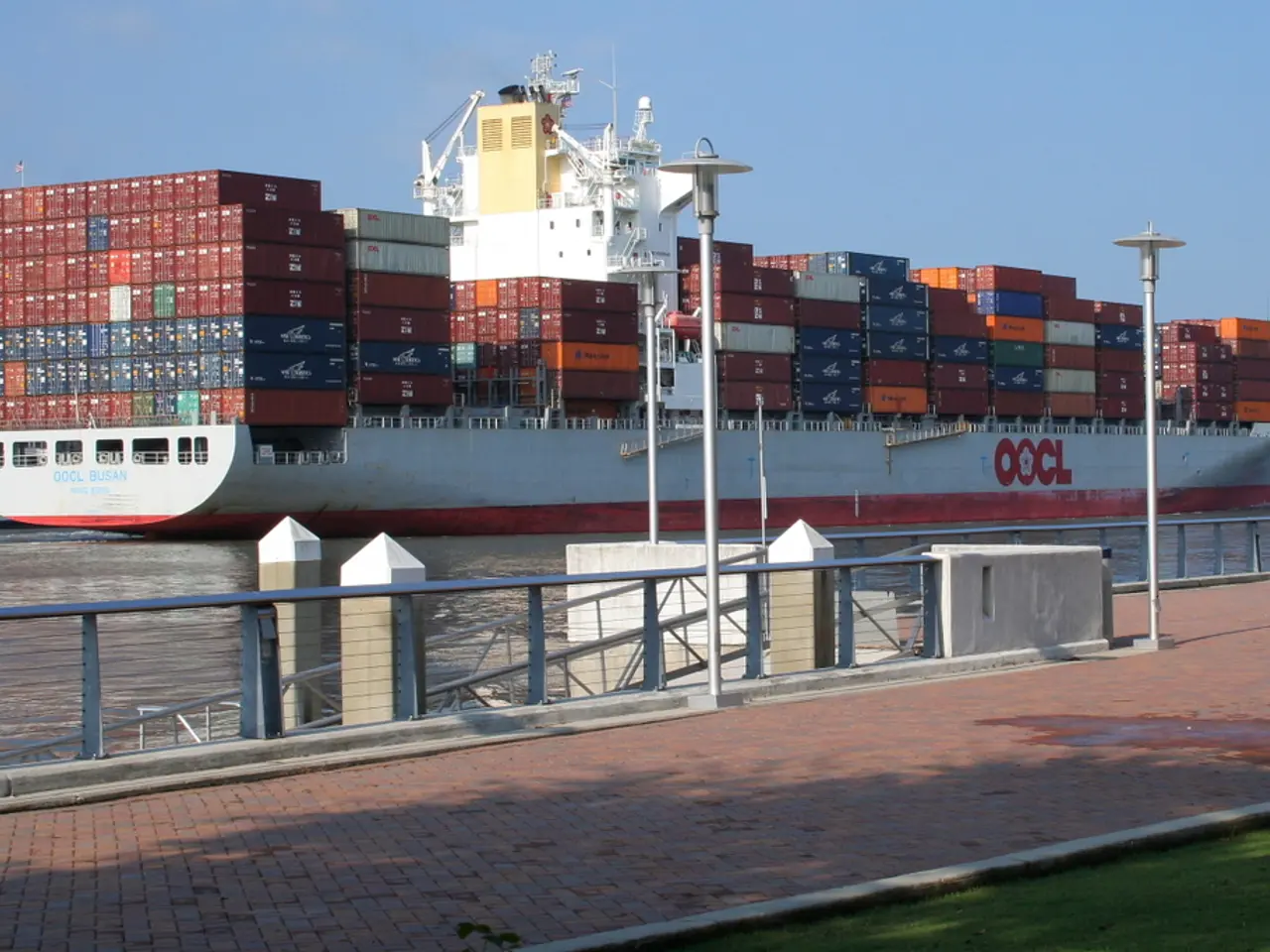
Majority of investors adjust investment strategies during trade tariff volatility, according to new data
Global Investors Adjust Portfolios Amidst Caution over US-China Trade Tensions
A recent survey by CoreData Research reveals that institutional investors worldwide are taking a cautious and defensive approach towards President Trump's trade policies. The survey, which polled 132 institutional investors and 22 institutional consultants, collectively managing over $4.9 trillion in assets, found that 77% of respondents are making tactical or strategic changes to their portfolios.
Two-thirds (66%) of global respondents are optimistic that a US-China trade agreement will be reached within the next year. However, 32% of global investors think the U.S. and China will fail to agree on a trade deal and reinstate trade barriers. This uncertainty is leading investors to hedge their exposure to the U.S. dollar, with 44% of global investors doing so.
The survey also found that 49% of investors have trimmed exposure to trade-sensitive assets. European investors are particularly active in this regard, with nearly two-thirds (65%) reducing exposure to U.S. assets. In contrast, APAC investors are more optimistic about a US-China trade agreement, with 73% being more optimistic than their peers in the U.S. (69%) and Europe (58%).
The tariffs imposed by President Trump are driving up input costs, fueling inflation concerns. J.P. Morgan Global Research notes a raised 40% risk of global recession this year partly due to the U.S. trade policy effects on global sentiment and trade flows. As a result, institutional investors are deploying both short-term tactical moves and longer-term strategic shifts to brace for heightened market volatility.
Michael Morley, head of CoreData U.S., stated that the research suggests that any optimism institutional investors have about the world's most important trade negotiations belies a sense that global trade has irrevocably changed, and thus, portfolio construction must adapt to a new reality. With a wide range of economic scenarios now very much in play, institutions are looking at ways to de-risk and build greater portfolio resilience.
To achieve this, 41% of global investors are rotating from growth to value stocks and/or defensive sectors. 40% of global investors are increasing cash allocations. Moreover, almost two-thirds of global investors expect Trump's trade policies to fuel structurally higher inflation and slower economic growth.
Europeans show elevated levels of concern about Trump's trade policies causing structurally higher inflation and slower economic growth (74%). Concern about a no deal scenario is highest among European investors, with 40% expecting significant upheaval.
In summary, institutional investors worldwide are actively adjusting their portfolios to reduce exposure to U.S. equities and sectors vulnerable to tariffs, increasing hedges against inflation, and seeking diversification outside the U.S. They are also wary of broader risks to global economic growth and shifts in currency and sovereign debt markets prompted by the ongoing and evolving U.S. tariff regime.
Investors are making tactical or strategic changes to their portfolios, mostly by trimming exposure to trade-sensitive assets and hedging against inflation, as a response to the uncertainty surrounding the US-China trade agreement. This cautious approach towards Presidents Trump's trade policies extends to the realm of finance, with many institutional investors considering deploying both short-term tactical moves and longer-term strategic shifts to brace for market volatility.






