
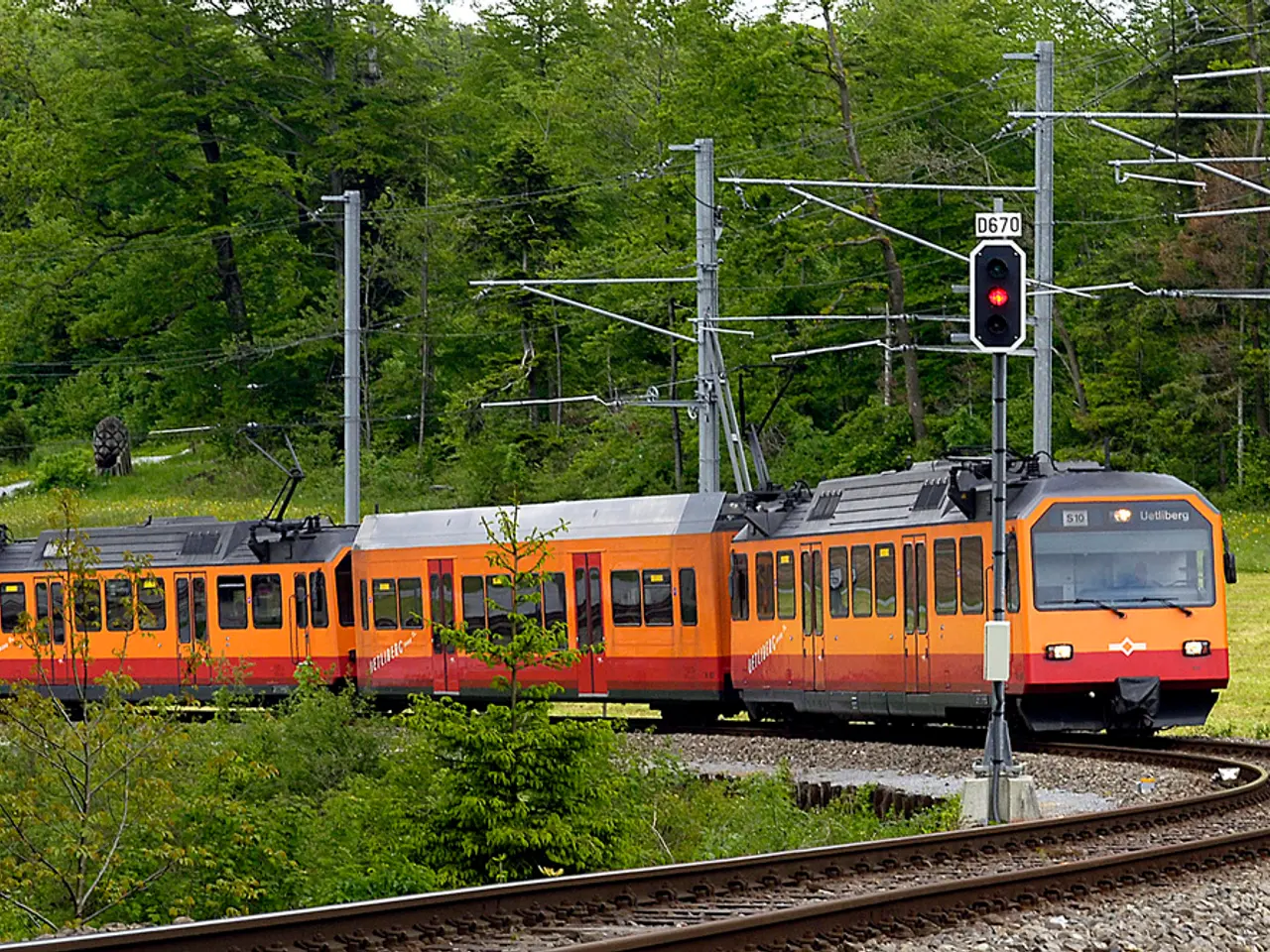
Companies increasingly opt for trains as a means of transporting equipment and decorations to the Festival d'Avignon, citing it as a tangible advantage.
The Avignon Festival, a renowned theatre event in France, is taking significant strides towards eco-friendliness by transporting its equipment and stage sets primarily by train instead of road or air. This change, which significantly lowers emissions associated with logistics, is part of a broader commitment to sustainability and the festival's ongoing efforts to reduce its carbon footprint.
The initiative to use trains, a more eco-friendly mode of transport, for moving heavy and bulky materials needed for the festival’s productions, has been in development since at least 2010. This is a part of the festival's Corporate Social Responsibility approach, which invests in innovative and large-scale actions, such as prioritizing rail over road transport to reduce carbon emissions from logistics.
This year, 80 companies participating in the Off festival have adopted this practice, and for the first time this summer, invited companies in the In festival have also chosen to use trains. The Avignon Festival aims not only to reduce its carbon footprint but also to serve as a model for responsible event management, emphasizing collective and systemic changes beyond simple measures like waste reduction.
One of the strategies involves pooling the transport of sets for several shows, particularly from the Ile-de-France region. The sets are put into railway containers and brought to their destination by train. Using this method saves time and maintenance, as it eliminates the need for unloading and reloading the sets. However, the efficiency of using freight trains is contingent upon the cities being far enough away to make it profitable and interesting.
Clara Moulin Thyrode, a Toulouse-based company, has expressed reservations about using freight trains due to the need to change platforms multiple times, making it less practical for a Toulouse company. Nevertheless, two companies, Nancy and the Comédie-Française, have responded positively to the proposal for train transportation within the In festival for the first year of experimentation.
Last year, the Off festival reported a 19-tonne reduction in CO2 emissions as part of its ongoing effort to reduce emissions. The sets of an opera programmed in Avignon were loaded into a container and sent directly to the logistics zone, avoiding storage in warehouses. The container will be retrieved on July 18th at the Opéra Grand Avignon.
The Avignon Festival's use of freight trains is a practice that has been implemented for the first time this year. This eco-friendly approach aligns with the festival's membership in ecological charters such as the Eco-Festival charter and collective efforts with other festivals in the Provence-Alpes-Côte d’Azur region. The festival's commitment to sustainability is a testament to its dedication to creating a more environmentally conscious future for the arts.
[1] Avignon Festival. (2025). Corporate Social Responsibility. Retrieved from https://www.festival-avignon.com/en/csr [5] Provence-Alpes-Côte d’Azur Regional Council. (2025). Eco-Festival charter. Retrieved from https://www.council-paca.fr/en/eco-festival-charter
- The Avignon Festival's adoption of train transportation for moving equipment and sets is an initiative rooted in environmental-science and sustainability, aligning with the festival's Corporate Social Responsibility approach and commitment to reducing carbon emissions associated with logistics.
- The use of freight trains for transporting festival sets is not only eco-friendly but also financially sensible, as it saves time and maintenance costs through the elimination of unloading and reloading, making it a viable option for distant cities.
- The Avignon Festival's commitment to sustainability extends beyond its own activities, as it is a member of the Eco-Festival charter and collaborates with other festivals in the Provence-Alpes-Côte d’Azur region to promote industry-wide changes and foster a more environmentally-conscious culture in the realm of arts and entertainment.






