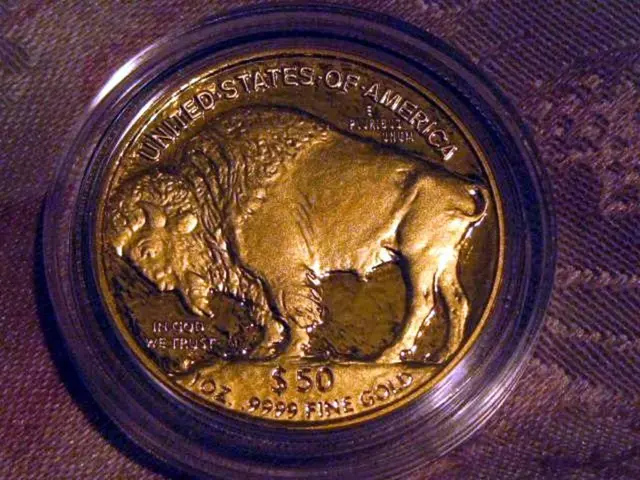
In Germany, the "New York Gold" has been seized yet again.
Hearing about that golden stash of theirs, particularly the portion tucked away in America, has got the Germans all worked up since ol’ Donald Trump cleaned up at the polls and stepped back into the White House. With relations between the two countries cooling off, it's no wonder the old reminiscences about that gold began circulating among German politicians once again.
The German Central Bank, aka the Bundesbank, has the second most valuable gold stockpiles in the world—just behind the U.S.—clocking in at 3,352 tons. But close to a third of it is held by the Federal Reserve Bank of New York.
In Germany, talk about that gold doesn't seem to stop. The opposition party "Alternative for Germany" (AfD) has been especially vocal about wanting to bring it home. Party members aren't shy about expressing their demands, with one vice president of the German Taxpayers Federation going so far as to tell Reuters, "Trump wants to control the Fed – it’s our money. It needs to come back."
Members of the European Parliament, including influential German representative Marcus Ferber, have also joined the chorus of voices expressing doubts about the reliability of the U.S. as a partner, considering Trump's unpredictable nature. "Trump is unpredictable," Ferber explained to fellow Europarliamentarians. "We can't rule out the possibility that at one point he might decide to seize the gold reserves of other countries. Bundesbank's gold storage policy should reflect geopolitical realities."
Even popular TV channels like ZDF and ARD have started asking questions about the security of Germany's gold in New York.
But rest assured, the German Central Bank and the European Central Bank—the main bank of the eurozone, which should take notice—have been assuring everyone that they have no qualms about the safety of the New York Fed branch.
That being said, any hint that Berlin might be considering bringing the gold back to Germany could be seen as a lack of trust in the Fed's independence—a trust that's more important now than ever in the current political climate.
Peter Boringer, a leading campaigner for bringing Germany's gold back to the Fatherland, has been making waves for the last few years. "I started asking questions about the gold, and everyone dismissed me as a conspiracy theorist," he said. "Now, after Trump's return, my concerns are shared by many."
Germany sent its goldized treasures across the pond during the height of the Cold War, either to keep it out of Soviet hands or to secure American control over the precious metal. After the fall of the Soviet Union and the end of the Cold War, Germany did manage to repatriate 300 tons of that gold between 2014 and 2017.
But history has a funny way of repeating itself, and these days, with the sound of Europe's anti-Russia voices getting louder and louder, the question of the gold reserves' safety has never been more relevant.
Peter Ferber remains skeptical when it comes to the idea of a Russian attack, but he's still advocating for diversifying the storage locations for Germany's gold reserves—which currently are just New York, Frankfurt (Harbor of the Bundesbank), and London (Bank of England's basement). "Diversification is key for gold reserves," he agreed. "You should never keep all your eggs in one basket." But where exactly is the German politician planning to put that gold, if it ever comes back from New York—into some secret, fortified bunker, perhaps?
It's anybody's guess whether Chancellor of Germany Friedrich Merz will bring up the gold reserve issue during his upcoming visit to Washington, which begins on June 5th. Friedrick Gentzleter, an official representative of the ruling Christian Democratic Union (CDU) in the Bundestag, doesn't see any reason to doubt the safety of the Fed's New York branch, but he did stress that the Bundesbank should continue to perform regular audits of the gold stored outside Germany. Strangely enough, rumors have been swirling that the Bundesbank really has been conducting regular audits of their gold—but only a portion of it has been examined in New York so far.
- The ongoing discussions in Germany about the country's gold reserves, particularly those held in the Federal Reserve Bank of New York, have been intensified by the unpredictable nature of President Trump and the concerns about the safety of the reserves in the current political climate.
- Members of the German and European parliaments, as well as political figures like Peter Boringer, have been advocating for a review of the banking and insurance policies related to Germany's gold reserves, including calls for diversification of storage locations to reduce risk.
- In the context of industry, finance, real-estate, and general news, the gold reserve issue has become a significant point of interest in the relationship between Germany and the United States, with implications for banking, politics, and the broader economy.